
Vaccinations for South East Asia: A Traveller’s Guide
Medically reviewed by Muhammad Adnan, Superintendent Pharmacist (GPhC reg. 2073652) · Reviewed 2026-05-31
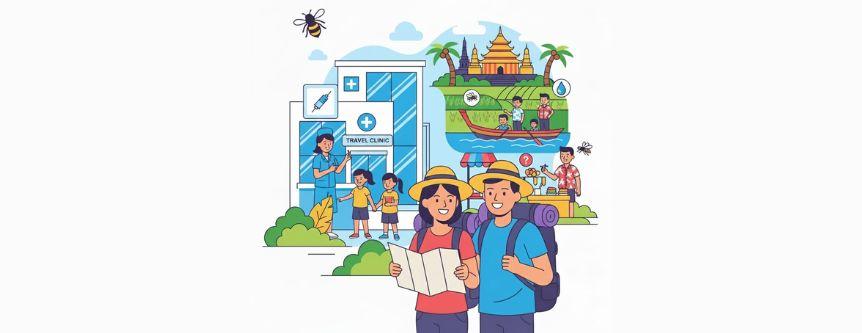
For most trips to South East Asia, the core recommendations are hepatitis A and typhoid alongside your routine NHS jabs, with hepatitis B, Japanese encephalitis or rabies added depending on where you're going and how long for. Malaria risk is generally low and patchy across the region, while dengue is widespread, so insect bite avoidance matters as much as any vaccine.
Whether you're heading to Thailand for a beach holiday, backpacking through Vietnam and Cambodia, or visiting family in the Philippines, a quick pre-travel review pays off. Here's how we think about it at the clinic.
What vaccines do I need for South East Asia?
There's no single fixed list, because your itinerary, length of stay and the sort of trip you're taking all change the picture. That said, the great majority of travellers fall into a familiar pattern.
- Hepatitis A – recommended for almost everyone travelling to the region, as it spreads through contaminated food and water. It's well tolerated and gives long-lasting protection. This one is free on the NHS for travel.
- Typhoid – also food and water-borne, and worth considering for most trips, particularly if you're staying somewhere with patchy sanitation, travelling for longer, or visiting friends and relatives. Available as an injection or oral capsules.
- Routine UK vaccines – this is the part people forget. Make sure your tetanus, diphtheria and polio cover is up to date, and that you've had your MMR doses. These quietly do a lot of the heavy lifting.
Depending on your plans, we may also discuss hepatitis B, Japanese encephalitis and rabies. More on those below. You can browse the full range on our travel vaccines page or use the vaccine finder.
Which extra vaccines depend on my trip?
These are the ones where your specific itinerary genuinely changes the advice.
- Hepatitis B – spread through blood and bodily fluids, so it becomes more relevant for longer stays, anyone who might need medical or dental care abroad, adventure travellers, or those who may get a tattoo or piercing. It's a private vaccine and usually given as a short course.
- Japanese encephalitis – a mosquito-borne brain infection found across much of rural South East Asia. According to TravelHealthPro, risk is highest for longer rural stays, typically a month or more, and during the wet season. Short, mainly urban trips are lower risk. It's a paid two-dose course given over a few weeks, so it needs a little planning.
- Rabies – present in dogs and other animals throughout the region. Pre-travel vaccination is worth considering for longer trips, remote travel, cyclists, runners, anyone working with animals, and young children, who tend not to report a lick or nip. It doesn't make you immune, but it simplifies and buys time on the treatment you'd need after a bite.
If you're unsure, that's exactly what a consultation is for. We match the vaccines to your route rather than handing everyone the same list.
Do I need malaria tablets for South East Asia?
Often, no, but it depends very much on where you're going. Across most of the region malaria risk is low and concentrated in specific rural and forested areas rather than the cities and main tourist spots.
Thailand is a good example. TravelHealthPro notes there's no malaria risk in places like Bangkok, Chiang Mai, Koh Samui and Pattaya, and only very low to low risk along the forested borders with Cambodia, Laos and Myanmar. In those lower-risk settings, antimalarial tablets usually aren't advised, but awareness and good bite avoidance still are. Higher-risk rural pockets elsewhere in the region may warrant tablets.
Because the right answer shifts from one border region to the next, this is best decided against your actual route. Our malaria advice page covers the basics, and we'll confirm whether tablets are sensible for your trip.
What about dengue?
Dengue is the bigger day-to-day mosquito concern for most travellers to South East Asia, and cases have climbed in recent years. Unlike malaria, the mosquitoes that carry it bite during the day, so protection isn't just an evening job.
There is now a dengue vaccine (Qdenga), but in the UK it's currently only considered for people who have had a confirmed dengue infection in the past, to reduce the risk of a more severe second episode. For first-time travellers, the mainstay is simple and effective: cover up, use a DEET-based repellent regularly, and keep it topped up through the day.
How early should I get vaccinated?
Ideally, see a travel health professional at least 4 to 6 weeks before you fly, as the NHS advises. Several vaccines need time to work, and a few are given as courses spread over weeks.
- Typhoid is best given around a month ahead.
- Japanese encephalitis is a two-dose course over a few weeks.
- Rabies and hepatitis B both involve more than one dose.
Left it late? It's still worth coming in. Many vaccines offer useful protection even close to departure, and getting some cover is far better than none. Being open seven days a week, late into the evening Monday to Saturday, with walk-ins and same-day appointments, means short-notice trips are usually still workable. As a registered Yellow Fever centre, we can also help if your wider itinerary touches a country that needs it.
A few region-specific notes
- City breaks (Bangkok, Singapore, Kuala Lumpur): usually hepatitis A, typhoid and routine cover, with strong emphasis on dengue bite avoidance.
- Rural and longer trips (northern Thailand, rural Vietnam, Cambodia, Laos): more likely to bring Japanese encephalitis, rabies and a malaria discussion into play.
- Backpacking and adventure travel: add hepatitis B and rabies to the conversation, given the mix of activities, accommodation and time spent off the beaten track.
- Visiting friends and relatives: often higher exposure to local food, water and rural areas, so typhoid and hepatitis A are particularly worth having.
Frequently asked questions
Is the hepatitis A or typhoid vaccine free?
Hepatitis A, typhoid, cholera and the polio-containing booster are available free on the NHS for travel, usually through your GP. Japanese encephalitis, rabies and hepatitis B are private vaccines, which we can provide here.
Are travel vaccines for South East Asia compulsory?
For most of the region they're recommended rather than legally required. The main exception is yellow fever, which some countries ask for if you're arriving from a country where it's present, so it's worth checking if your trip includes other stops.
Can children have these vaccines?
Yes. Most travel vaccines are suitable for children, with the schedule and doses adjusted for age. We'll assess each child individually as part of the consultation.
Country-by-country travel vaccine guides
For a destination-specific breakdown of what's commonly recommended, see our individual guides:
- Travel vaccines for Thailand
- Travel vaccines for Vietnam
- Travel vaccines for Cambodia
- Travel vaccines for Laos
- Travel vaccines for Malaysia
- Travel vaccines for the Philippines
- Travel vaccines for Indonesia & Bali
Travelling on to South Asia as well? See our guides for India, Sri Lanka and Nepal.
If you're planning a trip out to the region, it's worth a short chat to get the protection that fits your route rather than a one-size-fits-all list. You can book a travel consultation online, call us on 0161 948 5066, or simply walk in. We're here to help you travel well.
Planning this trip?
Book a travel health appointment in Timperley, or see our full travel-vaccine price list.